Homeowners across Heckmondwike use us for driveway cleaning, from Flush and Hightown out to Millbridge and nearby Batley, Cleckheaton and Dewsbury. We check the base and the drainage on every Heckmondwike drive we price, because the surface is rarely the whole story.
Heckmondwike Landscaping & Driveways cleans driveways across Heckmondwike using commercial pressure washers, surface cleaners and treatments matched to the paving you have. Driveway cleaning is the simplest form of driveway maintenance: it lifts dirt, algae, moss, tyre marks and oil from the surface so the paving looks like it did when it was laid and, more usefully, so it stops holding water and growing weeds. It suits any homeowner in Heckmondwike with a block paved, tarmac, concrete, resin or natural stone drive that has gone green, grey or patchy.
Most drives we visit have never been cleaned properly. A garden hose and a stiff brush move the loose dirt but leave the biofilm behind, which is why the green comes back within weeks. We work with a rotary surface cleaner and a lance for the edges, then re-sand or treat the surface depending on the material. We book cleans from early spring through to late autumn when the surface will dry properly afterwards.
Below we explain our three cleaning services, how we work, what changes the price and where in Heckmondwike we cover.
Driveway Pressure Washing
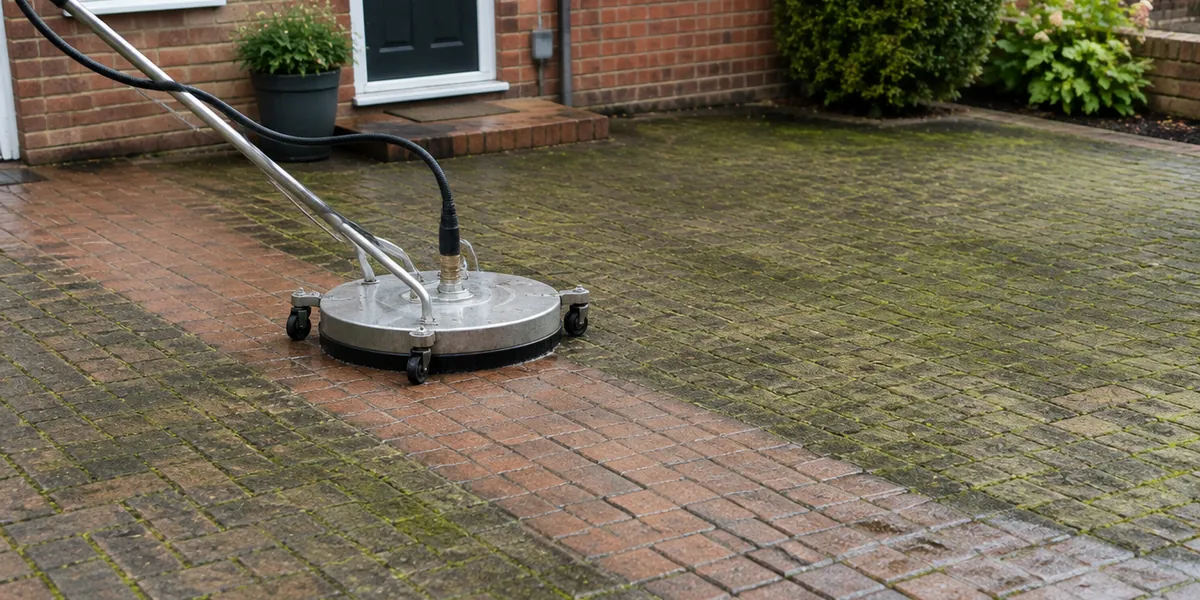
Pressure washing is the core of every driveway clean we do in Heckmondwike. It uses a petrol-driven machine running at 150 to 250 bar, with a flow rate high enough to flush the dirt away. On block paving and concrete we use a rotary surface cleaner, a flat hood with spinning jets, because it cleans in even stripes without the swirl marks a hand lance leaves on a large area.
It is the right choice when the drive is dull, blotchy or slippery but the surface itself is sound. If blocks are rocking or the tarmac is crumbling, cleaning will show up the damage rather than hide it, and we will tell you before we start. For a drive like that, repairs come first and Driveway Sealing can follow once it is clean and dry.
We sweep off loose debris, pre-wet the surface, apply a biocidal cleaner where there is heavy growth, then run the surface cleaner in overlapping passes. Joints are washed out on block paving, so we leave the drive to dry and then brush kiln-dried sand back in and compact it. On tarmac we keep the pressure lower and the nozzle further off the surface, because an aggressive jet pulls the fine aggregate out of an older drive.
The result depends on the age of the paving, how deep the staining has gone and whether the drive has been sealed before. An unsealed concrete drive that has sat under trees for ten years may still carry some shadowing after the first clean.
Driveway Oil Stain Removal
Oil is the stain homeowners in Heckmondwike ask about most. A car that drips engine oil, gearbox oil or power steering fluid in the same spot every night leaves a dark patch that pressure washing alone will not shift, because the oil has soaked into the surface rather than sat on top of it. Concrete and block paving are both porous, so the longer the stain has been there, the deeper it has travelled.
We treat oil stains as a separate stage before the main wash. For fresh stains we use an absorbent powder to draw out as much liquid as possible. For older stains we apply a solvent-based or alkaline degreaser, agitate it with a stiff brush, leave it to dwell, then rinse it out at high flow. Stubborn patches need a poultice, a thick paste left on the surface for a day or two that pulls the oil up as it dries.
Fresh oil comes out almost completely. Oil that has been there for years lightens a great deal but may leave a faint shadow, particularly on pale concrete. On block paving we have another option, which is to lift the worst two or three blocks, turn them over or swap them for spares from the edge, and re-sand. This is the right choice when the owner wants the patch gone entirely.
We also advise fitting a drip tray or sealing the drive once it is clean, because a sealed surface gives you time to wipe a spill up before it soaks in.
Driveway Moss and Algae Removal
Moss, algae and lichen are the main reasons a driveway in Heckmondwike goes green and slippery. Algae forms the green or black film you see on shaded tarmac and concrete, moss builds up in the sand joints of block paving, and lichen is the pale, crusty spots that look like dried paint and are the hardest of the three to remove. All of them hold moisture against the surface, which speeds up frost damage in winter.
Our approach has two parts. The first is physical removal: we scrape heavy moss out of joints with a joint scraper, or a wire brush on an angle grinder for the worst drives, then pressure wash the whole area. The second is chemical: we apply a biocide once the surface has dried and leave it on. It keeps working for months, killing spores the wash missed, which is why a treated drive stays clean so much longer than one that has only been washed.
This is the right choice for drives on the north side of a house, under trees or hedges, or anywhere the surface stays damp into the afternoon. It also makes sense before Block Paving Joint Maintenance, since there is no point putting fresh sand into joints still full of moss roots.
We prefer to treat in spring or early autumn, on a dry day with no rain forecast for 24 hours, so the biocide stays on the surface rather than washing into the gully. We keep it off lawn edges and planted borders.
What You Get When We Handle Your Driveway Cleaning
Many pressure washing jobs in Heckmondwike are done by whoever owns a machine. We lay and repair driveways, so we know what a jet does to a soft tarmac edge, a cracked block or a lime-mortar joint before we start. That keeps a clean from turning into a repair bill.
We bring our own water bowser where the mains pressure is poor, we use kiln-dried sand rather than building sand for re-jointing, and we match the biocide to the surface.
Every job comes with a written quote, we are insured for the work and we hold a waste carrier registration for the sludge we take away. If the drive has defects that cleaning will expose, you hear about them before we switch the machine on, not after.
Our Driveway Cleaning Process
- Survey: we look at the surface, check for loose blocks, soft tarmac and failed joints, and identify the staining so we quote for the right treatment.
- Preparation: cars are moved, pots and furniture lifted, nearby planting covered and the gully grating lifted so we can check it will take the run-off.
- Pre-treatment: oil stains are degreased and heavy moss is scraped or treated before the main wash.
- Wash: the rotary surface cleaner covers the open area in overlapping passes and the lance handles edges, steps and kerbs.
- Rinse and clear: debris is flushed to the gully, the gully is cleared and the lawn edges are rinsed.
- Dry and re-sand: block paving is left to dry, then kiln-dried sand is brushed into the joints and compacted.
- Treatment: a biocide is applied to keep growth away, and sealing is scheduled if you have asked for it.
A typical family driveway in Heckmondwike takes a morning to wash and an afternoon to dry and sand. Heavily lichened drives can run to two visits.
What Affects the Cost of Driveway Cleaning in Heckmondwike
The biggest factor is area. A single-car drive at the front of a terrace in Heckmondwike is a quick job; a double drive with a turning circle and side path is three or four times the surface and takes most of a day.
Surface type comes next. Block paving needs washing out and re-sanding, which adds labour and materials. Tarmac needs a gentler, slower technique. Resin-bound and natural stone need lower pressure and care around the edges.
The condition of the drive matters too. Heavy lichen, deep oil staining or moss that has rooted into every joint all mean more pre-treatment time and more product. Access affects the price when we cannot park close by or need to run hoses a long way. Water supply is a factor where there is no outside tap and we have to bring a bowser.
Finally, extras such as biocide treatment, sealing or lifting stained blocks are itemised separately on your written quote so you can see what each adds.
Driveway Cleaning Across Heckmondwike
We clean driveways across Heckmondwike and nearby Batley, Cleckheaton and Dewsbury. Our regulars include block paved drives in Norristhorpe on an annual wash and re-sand, and if your tarmac drive in Hightown is shaded, or your concrete drive in Millbridge is older and has never been treated, algae and moss will keep coming back until it is. We are often in Littletown for oil stain work, and if your drive in Flush is resin or natural stone, we take a gentler approach. If you are anywhere in Heckmondwike, we can usually quote from photographs and fit you in within a couple of weeks.
Other work we carry out across Heckmondwike include driveway sealing and block paving joint maintenance.
Frequently Asked Questions
How often should a driveway in Heckmondwike be cleaned?
Most drives in Heckmondwike benefit from a proper clean every one to two years. Shaded drives, drives under trees and block paving with sand joints need it more often, usually annually, because moss and algae return faster. A sealed drive and a biocide treatment both extend the gap between cleans.
Will pressure washing damage my block paving?
Not when it is done correctly. We use a surface cleaner rather than a bare lance, keep the pressure appropriate for the blocks and always re-sand the joints afterwards. The damage people see from pressure washing comes from washing the sand out and leaving the joints empty, which lets the blocks move.
Can you remove old oil stains completely?
Fresh oil usually comes out fully. Old oil that has soaked deep into concrete or blocks lightens a great deal but can leave a faint shadow. On block paving we can lift and replace the stained blocks to remove the mark entirely, which we will suggest at the survey if it is the better option.
Do I need to be at home while you clean the driveway?
No, as long as vehicles are moved off the drive, we have access to an outside tap or you have told us there is none, and we can get through any side gate. We will send you photographs when we finish and leave the drive clear for you to park on once it has dried.
What time of year is best for driveway cleaning?
Spring through to autumn is best, on a dry day. The surface needs to dry fully before we re-sand or apply biocide, and in winter that can take days. If you want the drive clean for a specific event in Heckmondwike, book a couple of weeks ahead so we can pick a dry slot.