We take on gravel driveway installation right across Heckmondwike and its WF15 and WF16 postcodes, from Norristhorpe and Hightown to Flush, plus nearby Batley, Cleckheaton and Dewsbury. If the drive needs a dropped kerb, the application goes to Kirklees Council as the highway authority; we help with it and keep front-garden surfaces within the permeable-surface rules.
Gravel gets dismissed as the cheap option, and it is true that a gravel driveway installation costs less than paving, but done properly it is also permeable, quick to lay, easy to extend and one of the better-looking surfaces for a larger or more rural Heckmondwike property. Heckmondwike Landscaping & Driveways builds loose gravel and crushed stone driveways across Heckmondwike, on a proper membrane and compacted sub-base with stabilising grids where the ground slopes or the traffic is heavy. This page is for anyone in Heckmondwike who likes the look and sound of gravel and wants it to stay where it is put.
The gravel drives that go wrong are the ones where stone was tipped straight onto soil. Within a year the stone has sunk into the mud, the weeds are through and there are ruts where the car turns. The ones that work have 150 mm of compacted stone under a thin decorative layer, firm edges all round and a grid under the areas that take the strain.
We survey every site, recommend the right build-up and depth of stone, and give you a written quote and a written guarantee on the work before anything is ordered.
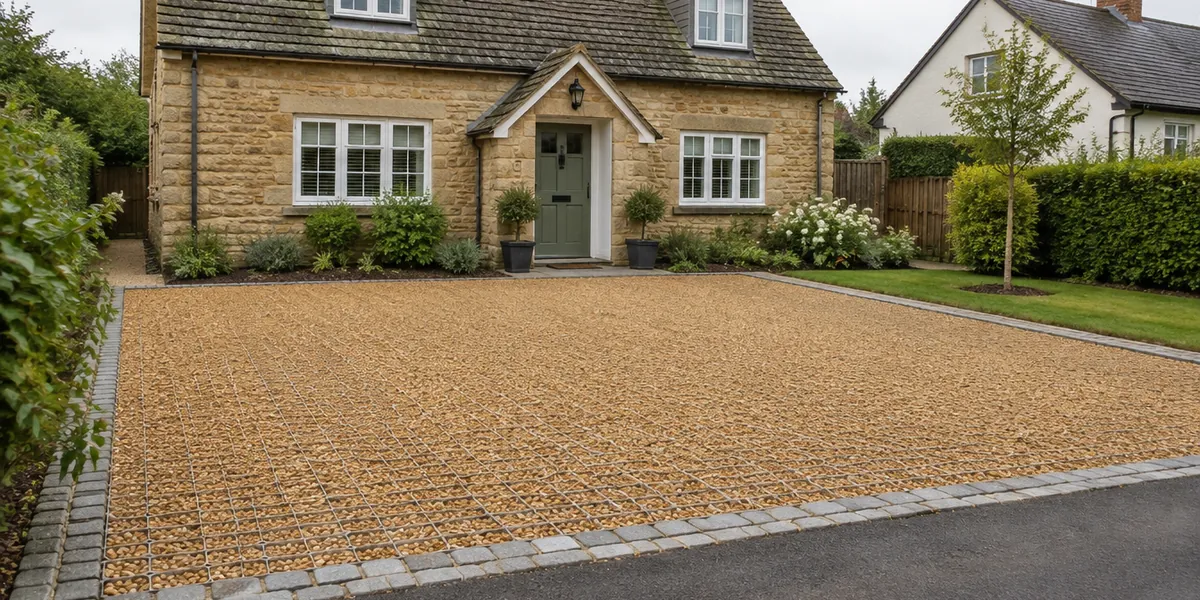
Loose Gravel Driveways
A loose gravel driveway uses a decorative aggregate, typically 10 to 20 mm, spread over a compacted sub-base to give a free-draining, crunching surface that suits country-style houses, long approaches and large frontages around Heckmondwike. It is the right choice when you want permeability without the cost of resin, when the drive is too long to pave economically, or when you may want to extend the parking area later.
Stone choice sets the character. Golden flint and Cotswold chippings give warm tones, slate chippings suit a modern look, granite and basalt are darker and hard-wearing, and pea shingle is the most economical but rolls underfoot. Angular gravel locks together better than rounded pebbles and is easier to push a pram or wheel a bin across.
Under the stone we strip the topsoil, lay a woven geotextile membrane to stop the sub-base mixing with the ground, then build 100 to 150 mm of Type 1 MOT compacted in layers. On slopes, turning areas and the strip where the tyres sit, we lay a honeycomb stabilising grid, pinned and filled with gravel, which stops the stone migrating and ruts forming. A 30 to 40 mm layer of decorative gravel finishes it; any deeper and it becomes hard going for tyres.
Edges hold a gravel drive together. We use timber, steel, concrete edging or a course of block paving set in concrete, and a short band of blocks or a drainage grid at the road so stone is not kicked onto the pavement.
Crushed Stone Driveways
A crushed stone driveway uses an angular, graded crushed aggregate, usually limestone or granite in a 20 mm down or 40 mm down grade, that compacts into a firm, bound surface rather than staying loose. It is the right choice for working drives in Heckmondwike, access tracks, parking for vans or trailers, and anywhere you want a solid, low-cost, permeable surface that does not shift under a tyre.
The difference from loose gravel is in the stone. Crushed material has sharp faces and contains fines, the dust and small particles that fill the gaps between larger pieces. Compacted with a vibrating roller or plate, the fines lock the larger stones together and the surface becomes hard enough to walk on in heels and to sweep.
We build it as a thickened sub-base. After excavation and a geotextile membrane we lay crushed stone in two or three compacted layers to a total depth of 150 to 200 mm, with a slight camber so water runs off to the sides rather than pooling. On very soft ground in Heckmondwike a capping layer of 40 to 75 mm stone goes down first. The top layer is wetted and rolled until the surface is tight.
Crushed stone is the easiest driveway surface to maintain. A rut or low spot is simply topped up and compacted. It can also serve as the base for a future tarmac, block paving or resin driveway installation, which makes it a sensible first step for a new-build plot or a budget spread over several years.
What You Get When We Handle Your Gravel Driveway Installation
Because we build a gravel driveway the way we build a paved one, from the ground up. The base is excavated, membraned and compacted to the same standard we use under block paving, the edges are set in concrete and the gravel is the final layer rather than the whole job. That is why our gravel drives around Heckmondwike still look tidy years later.
Our team knows the local ground and which parts of Heckmondwike need a capping layer or a deeper sub-base. We carry stabilising grids as standard rather than as an afterthought, so sloping drives and tyre tracks are dealt with on the first visit. Decorative stone is sourced in bulk bags or loose loads from suppliers we trust, so colour and grading are consistent.
You get a written quote listing the excavation, membrane, sub-base, grids, edging and stone separately, a written guarantee on the installation, legal waste disposal and honest advice. If a resin-bound drive or block paving would serve you better, we will say so before you commit.
Gravel Driveway Installation: Step by Step
- Survey. We measure the drive, assess the ground and gradient, identify where a stabilising grid is needed and look at samples of stone with you.
- Written quote. You receive an itemised quote with depths and materials listed, plus a start date.
- Excavation. Topsoil and any old surface are stripped to around 200 mm below finished level and taken away.
- Membrane and edging. A geotextile membrane is laid and overlapped, and the edges are set in concrete to hold the stone in.
- Sub-base. Type 1 MOT or crushed stone is laid and compacted in layers, with the falls set so water drains to the sides or to a soakaway.
- Stabilising grid. Where specified, honeycomb grids are laid, pinned and filled with stone on slopes, tyre tracks and turning areas.
- Finishing. The decorative gravel is spread, raked to an even 30 to 40 mm and the site is cleared and swept.
A gravel driveway installation in Heckmondwike is usually finished in two to four working days, and you can drive on it as soon as we have gone.
What Affects the Cost of Gravel Driveway Installation in Heckmondwike
The area is the main driver, as the sub-base and membrane are costed per square metre. After that, the depth of excavation and stone depends on the ground. A firm, well-drained Heckmondwike plot needs less build-up than soft clay or made ground that requires a capping layer.
The decorative stone varies a lot in price by type. Pea shingle and local crushed limestone sit at the lower end, with slate, granite and premium flint chippings above. Stabilising grids add to the cost per square metre but save money in the long run by cutting top-ups and ruts, so we specify them only where they are needed.
Edging type, from treated timber to steel to concrete kerbs or block borders, makes a difference, as does any drainage grid at the road, removal of an old drive and the ease of access for tipper deliveries. Larger drives benefit from loose loads rather than bulk bags, which brings the per-tonne cost of stone down.
Gravel Driveway Installation Throughout Heckmondwike
Gravel suits larger plots best, so if your home in Hightown or Flush has a longer drive or a bigger frontage, where paving gets expensive, gravel is the sensible choice. That said, if you have a smaller house in Norristhorpe or Millbridge, a short gravel drive with a block paved apron gives a cottage feel and keeps the front garden permeable. In Littletown we often lay crushed stone as hard standing for a caravan or trailer beside the house. We also cover nearby Batley, Cleckheaton and Dewsbury.
Customers in Heckmondwike often ask us about concrete driveway installation and tarmac driveway installation at the same time.
Frequently Asked Questions
How deep should a gravel driveway be?
The decorative gravel layer should be only 30 to 40 mm, enough to cover the base but not so deep that tyres and feet sink in. Under that we build 100 to 150 mm of compacted Type 1 or crushed stone on a membrane. On soft ground in Heckmondwike the base goes deeper, because the base, not the gravel, is what carries the car.
Will the gravel spread onto the lawn and the road?
Not if the drive is edged properly and the stone is at the right depth. We set timber, steel, concrete or block edging on all sides and lay a short band of block paving or a drainage grid at the road, so the car does not drag stone onto the pavement. A stabilising grid under the turning area keeps the gravel in place too.
Do gravel driveways need planning permission?
Gravel is a permeable surface, so you can usually lay a gravel driveway of any size at the front of a house in Heckmondwike without planning permission. Conservation areas, listed buildings and any new access onto a classified road still need checking, and a dropped kerb needs the highways authority's approval, which we help with.
How much maintenance does a gravel driveway need?
Rake it level now and then, pull or treat the occasional weed that germinates in blown-in leaf litter, and top up the stone every few years as some is lost to tyres and brooms. A leaf blower keeps it tidy in autumn. Crushed stone drives need even less, just an occasional top-up and compaction of any low spots.
Is a gravel driveway suitable for a sloping site?
Yes, with a stabilising grid. On a gradient, loose gravel migrates downhill under tyres and rain. A honeycomb grid pinned to the sub-base and filled with stone holds the gravel in its cells, so the surface stays even and driveable. For steep drives in Heckmondwike we may still suggest a bound surface such as resin or tarmac instead.