We provide garden border and edging installation throughout the WF15 and WF16 postcode districts of Heckmondwike, from Littletown to Hightown, and in nearby Batley, Cleckheaton and Dewsbury. Every job starts with a free site visit in Heckmondwike, where we measure up, check access and talk through options before sending a written quote.
Edging is the detail that makes a garden look finished. It is the line between lawn and border, the restraint that stops a gravel path spreading, the kerb that keeps block paving tight after years of cars. Heckmondwike Landscaping & Driveways installs garden borders and edging in natural stone, brick and concrete kerb for homeowners throughout Heckmondwike, either as a job in its own right or as part of a larger paving or planting scheme.
Edging suits anyone whose lawn edges have crumbled into the beds, whose driveway blocks are creeping sideways, or who has laid gravel and is tired of raking it out of the grass. It is also the cheapest way to make an ordinary garden look deliberately designed. Our team sets every length of edging on a concrete bed with a haunch behind it, because edging that is just pushed into the soil does not last a season.
Here we cover the three edging types we fit most in Heckmondwike, how each is installed and what affects the cost. Edging is often done alongside Patio Installation and Garden Wall Construction, and for a new border we can prepare the soil and plant it as well.
Where We Offer Stone Edging Installation
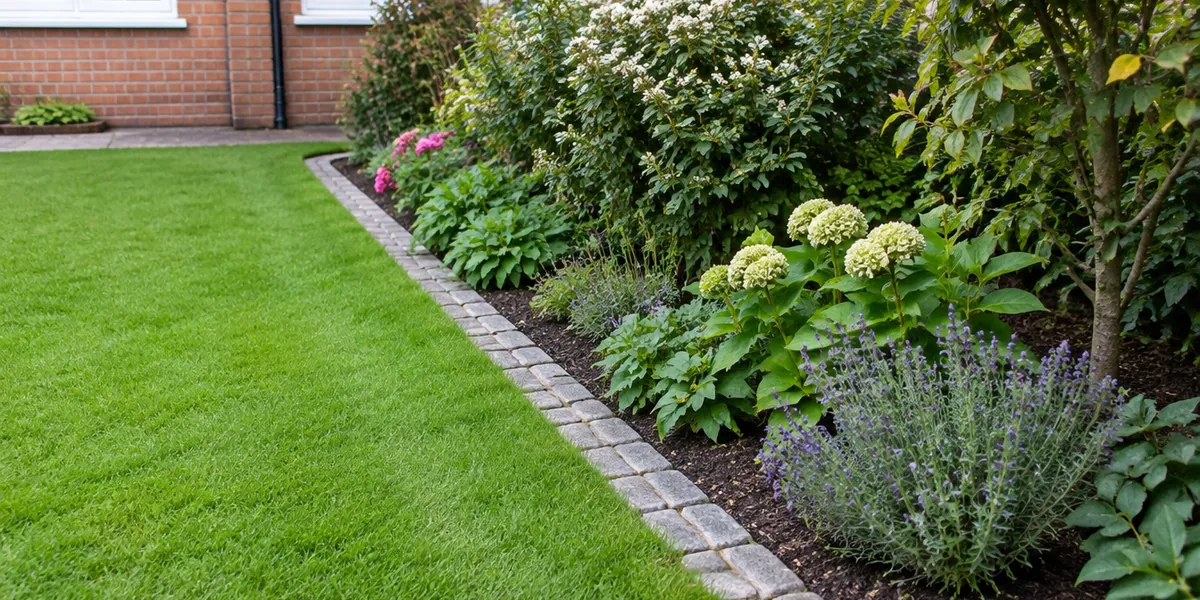
Stone edging means natural stone setts, sawn stone kerbs or tumbled sandstone blocks laid in a continuous line to define a lawn, border, path or gravel area. It is the right choice when the rest of the garden uses natural stone, when you want a softer, more irregular line than brick gives, or when the edging needs to follow a curve. Granite setts are almost indestructible and suit both cottage-style and modern gardens in Heckmondwike.
The usual sizes are 100 mm granite setts for tight curves and paths, 100 by 100 by 200 mm sandstone setts for borders, and 150 mm high sawn sandstone kerbs for a crisp straight edge beside a patio. Setts can be laid flush with the lawn so the mower runs over them, or set 25 to 50 mm proud to hold back mulch or gravel.
We dig a trench, lay a bed of semi-dry concrete, tap each sett down to a string line and then haunch the back with concrete up to two-thirds of the height. On lawn edges the haunch is kept low on the grass side so the mower blade clears it. Joints are pointed with a matching mortar, or brushed with kiln-dried sand where the setts are tight together.
Natural stone varies, so we sort the setts as we go to keep the colour even. What makes or breaks the result is a consistent line, concrete under every unit rather than just at the ends, and the height against whatever surface sits next to it.
Brick Edging Installation
Brick edging uses clay paving bricks or engineering bricks laid on edge, flat or at an angle to form a border. It is the right choice for houses in Heckmondwike where the brick can be matched to the building, for block paved driveways that need a soldier course, and for traditional gardens where a sawtooth edge of angled bricks suits the style. Brick is cheaper than natural stone, easy to lay to a straight line, and copes with curves if laid on end.
We use frost-resistant clay paving bricks or Class B engineering bricks, never ordinary house bricks, because facing bricks absorb water and spall after a few winters at ground level. Soldier course means bricks standing upright side by side; brick-on-edge means them lying on their narrow side; basketweave mixes orientations for a wider band.
The installation follows the same rule as everything else we do: a trench, a bed of concrete, each brick tapped down to a line, and a concrete haunch behind. For driveway edges the haunch is heavier, because the edging has to resist a car turning on the blocks. Bricks are laid tight-jointed with sand in the gaps, or pointed with a 10 mm mortar joint for a more formal look.
The result depends on the right brick, a true top line, and leaving the edging to cure for a couple of days before paving or gravel goes against it. We also check that water can still get off the paving: a brick edge standing proud of a patio with no gap will dam the rain, so we plan the levels together.
Concrete Kerb Edging Installation
Concrete kerb edging covers pre-cast concrete edgings, from the small 150 by 50 mm EF edging kerbs used around paths and lawns up to the full-size road kerbs we set along driveways and shared accesses. It is the right choice when the edging is structural and will be hidden by turf or gravel, when the budget is tight, or when a driveway needs a heavy restraint where cars mount it. Many block paved drives rely on a concrete kerb hidden under the lawn.
Pre-cast kerbs come in flat-top, round-top and bullnose profiles, in grey or buff, in 915 mm lengths. Moulded rope-top or scalloped units give a decorative line but are weaker, so we only use them where nothing will drive over them. Full driveway kerbs can be laid flush with the paving, upstanding by 25 mm to stop gravel escaping, or dropped at the entrance to match the pavement crossing.
Installation is a trench, a 100 mm bed of C20 concrete, the kerb tapped to line and level with a rubber mallet, then a concrete haunch to at least half the kerb height on the outer side. On a driveway the kerb line is set before the sub-base goes in, so the Type 1 and the blocks are compacted against something solid.
Concrete edging is unglamorous but it does the heavy lifting. The result depends on continuous bedding, straight joints and tight cuts on curves, made with a diamond saw rather than a bolster. Where a dropped kerb to the public footpath is needed we can advise on the council application, since that part is done by an approved contractor.
What You Get When We Handle Your Garden Border and Edging Installation
Edging is the sort of job that gets rushed at the end of a bigger project, and it shows. We have replaced plenty in Heckmondwike that was pushed into soil or set on dabs of mortar and had wandered off line within a year. Every length we fit sits on a continuous concrete bed with a haunch behind it, checked with a string and a level.
Because we also do paving, walls and planting, the edging is planned with everything else rather than bolted on. The height is set against the finished patio, the lawn is cut back so the mower runs clean, and the gravel or bark finishes at the right level. You get a written quote that names the product and the bedding, and a written guarantee on the work.
We bring samples of the stone or brick, keep the site tidy, and as registered waste carriers we take the spoil away with us. If you only want a few metres done we will still come and do it properly.
How Our Garden Border and Edging Installation Works
- Walk round and measure: we look at what the edging has to do, where the levels are, and whether there are roots, pipes or cables along the line.
- Samples and quote: you choose from stone, brick or concrete samples and get a written quote with the metreage, product and bedding detail.
- Setting out: we run a string line or a hose for curves, agree the exact position with you, and mark it on the ground.
- Trenching: a trench is dug to take the concrete bed, the edging unit and the haunch, with turf lifted cleanly where the edge runs along a lawn.
- Bedding and laying: units are tapped onto a semi-dry concrete bed to the line and level, with cuts made by saw on curves and at corners.
- Haunching and pointing: concrete is packed behind each unit, joints are pointed or sanded, and the face is cleaned off.
- Finishing: turf, gravel or soil is reinstated against the edging and the site is cleared.
A typical lawn or border edging job in Heckmondwike takes one to two days. We leave the concrete to cure for 48 hours before anything is compacted or driven against it.
Garden Border and Edging Installation in Heckmondwike: What Changes the Price
Length is the starting point, and the price per metre moves with the material. Pre-cast concrete edging is the most economical, clay paving bricks sit in the middle, and granite or sawn sandstone setts cost the most to buy and take longest to lay. Curves add time because every unit is cut or the pattern is adjusted, whereas a straight run from a string line goes quickly.
What is being edged matters. A lawn edge needs a shallow trench and a light haunch. A driveway edge needs a deeper bed, a heavier haunch and often removing the old edging and some of the sub-base first. Edging set proud, with pointing, takes longer than flush edging with sand joints.
Ground conditions add to the work when tree roots cross the line or the soil is full of old rubble. Access affects how we get concrete to the back garden. We list everything separately on the quote so you can decide, for instance, whether the back border really needs stone or whether concrete under the turf would do.
Garden Border and Edging Installation Around Heckmondwike
Edging work takes us to every part of Heckmondwike. In Norristhorpe we lay a lot of brick soldier courses along block paved front gardens, while a larger lawn in Hightown wants long runs of flush concrete or stone mowing edges. If you have a gravel driveway in Millbridge, it needs an upstanding kerb to keep the stone in, and if your newer home in Littletown or Flush came with borders left as bare soil by the builder, sett edging tidies them. We quote for free anywhere in Heckmondwike and nearby Batley, Cleckheaton and Dewsbury.
Many customers combine this with hard landscaping.
Common Questions
Does garden edging need to be set in concrete?
For anything you want to last, yes. Edging pushed into soil or laid on sand moves with frost, mowing and foot traffic within a year. We lay every unit on a semi-dry concrete bed with a concrete haunch behind it, which is why the lines stay straight and the heights stay where we set them.
What is a mowing edge and is it worth having?
A mowing edge is a flush strip of edging between the lawn and a border or wall, set level with the turf so the mower wheels run along it and cut right to the edge. It removes the need to strim or trim by hand. In Heckmondwike gardens with lots of border it saves a good deal of weekly work.
Can edging be laid in a curve?
Yes. Small units such as granite setts, bricks on end and short concrete edgings follow curves well. Long 915 mm kerbs can be cut into shorter pieces on tight bends. We set curves out with a hose or a flexible line first so you can see the shape before we dig.
What edging works best for a gravel driveway?
A concrete kerb or a sawn stone kerb set 25 to 40 mm above the gravel, bedded and haunched in concrete, stops the stone migrating onto the lawn or pavement. Where you want it to look smarter, granite setts or a double brick edge do the same job at a higher cost.
Can you replace my old edging without disturbing the lawn?
We lift the turf along the line in strips, remove the old edging and its concrete, lay the new edging and then relay the turf against it. There will be a narrow band that needs a few weeks to knit back together, but we keep the disturbance to the minimum needed to get a proper bed under the new units.